
Christian symbols and their Meaning
Christian symbolism invests objects or actions with an inner meaning expressing Christian ideas. Christianity has borrowed from the common stock of significant symbols known to most periods and to all regions of the world. Religious symbolism is effective when it appeals to both the intellect and the emotions. The choice of suitable acts and objects for symbolism is narrow enough that it would not be easy to avoid the appearance of an imitation of other traditions, even if there had been a deliberate attempt to invent an entirely new ritual.
The early Church widely used elemental symbols. Water has specific symbolic significance for Christians. Outside of baptism, water may represent cleansing or purity. Fire, especially in the form of a candle flame, represents both the Holy Spirit and light. The sources of these symbols derive from the Bible; for example, from the tongues of fire that symbolized the Holy Spirit at Pentecost and from Jesus’ description of his followers as the light of the world, or God is a consuming fire found in Hebrews 12. The cross, which is today one of the most widely recognized symbols in the world, was used as a symbol from the earliest times.
Among the symbols employed by the early Christians, that of the fish seems to have ranked first in importance. Indeed, from monumental sources such as tombs, we know that the symbolic fish was familiar to Christians from the earliest times. It can be seen in such Roman monuments as the Capella Greca and the Sacrament Chapels of the Catacomb of St. Callistus. The fish was depicted as a Christian symbol in the first decades of the 2nd century.

Ancient people believed that the flesh of a peafowl did not decay after death, and it so became a symbol of immortality. Early Christianity adopted this symbolism, and thus, many early Christian paintings and mosaics show the peacock. The peacock is still used in the Easter season, especially in the East.
Here are some of the most popular Christian symbols.
 The**Chi Rho** is one of the earliest cruciform symbols used by Christians. It is formed by superimposing the first two letters of the word “Christ” in Greek, chi = ch, and rho = r. Although not technically a cross, the Chi Rho invokes the crucifixion of Jesus as well as symbolizing his status as the Christ. The earliest evidence of the Chi Rho symbol is Constantine’s use of it on the labarum, the imperial standard, in the early 4th century CE. Lactantius, a 4th-century Christian apologist, reports that on the eve of the Battle of the Milvian Bridge in 312 CE, Constantine had a vision of God in which he was commanded to mark his men’s shields with the Chi Rho symbol. After Constantine’s success at the Milvian bridge, the Chi-Rho became the official imperial insignia. Archaeologists have uncovered evidence demonstrating that the Chi Rho was emblazoned on the helmet and shield of Constantine as well as those of all of his soldiers. Coins and medallions minted during Constantine’s reign also bore the Chi Rho. By the year 350 CE, the Chi Rho began to be used on Christian sarcophagi and frescoes. [A.E.M.] The**Chi Rho** is one of the earliest cruciform symbols used by Christians. It is formed by superimposing the first two letters of the word “Christ” in Greek, chi = ch, and rho = r. Although not technically a cross, the Chi Rho invokes the crucifixion of Jesus as well as symbolizing his status as the Christ. The earliest evidence of the Chi Rho symbol is Constantine’s use of it on the labarum, the imperial standard, in the early 4th century CE. Lactantius, a 4th-century Christian apologist, reports that on the eve of the Battle of the Milvian Bridge in 312 CE, Constantine had a vision of God in which he was commanded to mark his men’s shields with the Chi Rho symbol. After Constantine’s success at the Milvian bridge, the Chi-Rho became the official imperial insignia. Archaeologists have uncovered evidence demonstrating that the Chi Rho was emblazoned on the helmet and shield of Constantine as well as those of all of his soldiers. Coins and medallions minted during Constantine’s reign also bore the Chi Rho. By the year 350 CE, the Chi Rho began to be used on Christian sarcophagi and frescoes. [A.E.M.] | 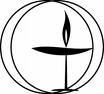 The philosopher A.N. Whitehead said that real symbols have the power to change history. The history of the chalice symbol is significant. It began by representing the religious courage of Jan Hus, a 15th-century Czech priest who was martyred for offering communion to his congregants in defiance of the Roman church, which reserved the sharing of wine to priests only. He was burnt at the stake for this act, and Unitarians have a history of being persecuted for innovative and democratic deeds in religion. The philosopher A.N. Whitehead said that real symbols have the power to change history. The history of the chalice symbol is significant. It began by representing the religious courage of Jan Hus, a 15th-century Czech priest who was martyred for offering communion to his congregants in defiance of the Roman church, which reserved the sharing of wine to priests only. He was burnt at the stake for this act, and Unitarians have a history of being persecuted for innovative and democratic deeds in religion. |
|---|---|
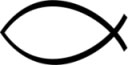 Ichthus (ikh-thoos) or ichthys is the Greek word simply meaning “fish”. Ichthus (ikh-thoos) or ichthys is the Greek word simply meaning “fish”. | |
| The Greek spelling for ichthus is — Iota, Chi, Theta, Upsilon, and Sigma. The English translation is IXOYE. The five Greek letters mean, “Jesus Christ, Son of God, Savior.” The Greek rendering is, “Iesous Christos, Theou Uios, Soter.” | |
| This symbol was used primarily amongst Christians of the early church years (1st and 2nd century A.D.) The symbol was introduced from Alexandria, Egypt, which, at the time, was a very heavily populated seaport. It was the port in which many goods were brought over from the European continent. Because of this, it was first used by the peoples of the sea as a symbol of a familiar deity, in this case, Jesus Christ. |  After his commission at the foot of the San Damiano Cross, Saint Francis chose a more ancient symbol of redemption as his standard: the Tau cross.In commenting on the scriptures of Israel, the early Christian writers used its Greek translation, the Septuagint, in which the last letter of the Hebrew alphabet, the tau, was transcribed as a “T” in Greek. Prefigured in the last letter of the Hebrew alphabet, the stylized Tau cross came to represent the means by which Christ reversed the disobedience of the old Adam and became our Savior as the “New Adam.” After his commission at the foot of the San Damiano Cross, Saint Francis chose a more ancient symbol of redemption as his standard: the Tau cross.In commenting on the scriptures of Israel, the early Christian writers used its Greek translation, the Septuagint, in which the last letter of the Hebrew alphabet, the tau, was transcribed as a “T” in Greek. Prefigured in the last letter of the Hebrew alphabet, the stylized Tau cross came to represent the means by which Christ reversed the disobedience of the old Adam and became our Savior as the “New Adam.” |
 The Latin Cross is also known as the Protestant Cross and Western Cross Latin cross. The Latin Cross is also known as the Protestant Cross and Western Cross Latin cross. | |
| The Latin cross (crux ordinary) is a symbol of Christianity, even though it was used as a pagan symbol for millennia before the foundation of the Christian Church. | |
| It has been found in China and Africa. It appears on Scandinavian Bronze Age stones depicting the hammer of Thor, their god of thunder and war. It was regarded as a magical symbol. It brought good luck and diverted evil. Some people interpret rock carvings of the cross as a solar symbol or a symbol of Earth, with its points representing north, south, east, and west. Others say it represents the human form. | 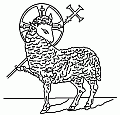 Lamb: a symbol of Christ as the Paschal Lamb and also a symbol for Christians (as Christ is our Shepherd and Peter was told to feed His sheep). The lamb is also a symbol for St. Agnes (Feast Day 21 January), a virgin martyr of the early Church. Lamb: a symbol of Christ as the Paschal Lamb and also a symbol for Christians (as Christ is our Shepherd and Peter was told to feed His sheep). The lamb is also a symbol for St. Agnes (Feast Day 21 January), a virgin martyr of the early Church. |
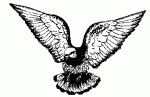 Dove: A symbol of the Holy Ghost, it is used especially in representations of our Lord’s Baptism and the Pentecost. It also symbolizes the release of the soul in death and is used to recall Noah’s dove, a harbinger of hope. Dove: A symbol of the Holy Ghost, it is used especially in representations of our Lord’s Baptism and the Pentecost. It also symbolizes the release of the soul in death and is used to recall Noah’s dove, a harbinger of hope. | 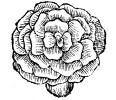 Rose : the Holy Faith, Our Lady, martyrdom, the secrecy of penance. Five roses grouped together to symbolize the 5 Wounds of Christ. Rose : the Holy Faith, Our Lady, martyrdom, the secrecy of penance. Five roses grouped together to symbolize the 5 Wounds of Christ. |
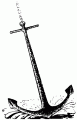 Anchor: found in the first-century cemetery of St. Domitilla, the second and third-century epitaphs of the catacombs, and especially in the oldest parts of the cemeteries of Sts. Priscilla (about 70 examples in this cemetery alone), Domitilla, Calixtus, and the Coemetarium Majus. See Hebrews 6:19. Anchor: found in the first-century cemetery of St. Domitilla, the second and third-century epitaphs of the catacombs, and especially in the oldest parts of the cemeteries of Sts. Priscilla (about 70 examples in this cemetery alone), Domitilla, Calixtus, and the Coemetarium Majus. See Hebrews 6:19. |  Jerusalem Cross: also called the “Crusaders’ Cross,” it is made up of 5 Greek Crosses which are said to symbolize a) the 5 Wounds of Christ and/or b) the 4 Gospels and the four corners of the earth (the four smaller crosses) and Christ Himself (the large Cross). This Cross was a common symbol used during the wars against Islamic aggression. Jerusalem Cross: also called the “Crusaders’ Cross,” it is made up of 5 Greek Crosses which are said to symbolize a) the 5 Wounds of Christ and/or b) the 4 Gospels and the four corners of the earth (the four smaller crosses) and Christ Himself (the large Cross). This Cross was a common symbol used during the wars against Islamic aggression. |
 Baptismal Cross: consisting of the Greek Cross with the Greek letter “X,” the first initial of the title “Christ,” this Cross is a symbol of regeneration, hence, its association with Baptism. Baptismal Cross: consisting of the Greek Cross with the Greek letter “X,” the first initial of the title “Christ,” this Cross is a symbol of regeneration, hence, its association with Baptism. |  Peter’s Cross : because when Peter was to be martyred, he chose to be crucified upside-down out of respect for Christ, the upside-down Latin Cross has become his symbol and, thereby, a symbol of the papacy. Sadly, this cross has been co-opted by Satanists whose purpose of “inverting” Christianity (e.g. as in their Black ‘Masses’) is expressed by taking the Latin Cross of Christ and inverting it. Peter’s Cross : because when Peter was to be martyred, he chose to be crucified upside-down out of respect for Christ, the upside-down Latin Cross has become his symbol and, thereby, a symbol of the papacy. Sadly, this cross has been co-opted by Satanists whose purpose of “inverting” Christianity (e.g. as in their Black ‘Masses’) is expressed by taking the Latin Cross of Christ and inverting it. |
 Fire, especially in the form of a candle flame, represents both the Holy Spirit and light. Fire, especially in the form of a candle flame, represents both the Holy Spirit and light. |
 Christian Cross -The Christian cross, seen as a representation of the instrument of the crucifixion of Jesus Christ, is the best-known religious symbol of Christianity. It is related to the crucifix (a cross that includes a usually three-dimensional representation of Jesus’ body) and to the more general family of cross symbols.The cross-shaped sign, represented in its simplest form by a crossing of two lines at right angles, greatly antedates, in both East and West, the introduction of Christianity. It goes back to a very remote period of human civilization. It is supposed to have been used not just for its ornamental value, but also with religious significance.
The Christian Cross comes in many different forms. Here are a few of the different forms of the Christian Cross.Latin Cross New Coptic Cross
 Crucifix – cross with a representation of Jesus’ body hanging from it. It is primarily used in Catholic, Anglican, Lutheran, and Eastern Orthodox churches (where the figure is painted), and it emphasizes Christ’s sacrifice – his death by crucifixion.Patriarchal CrossA double cross, with the two crossbars near the top. The upper one is shorter, representing the plaque nailed to Jesus’ cross.
 Cross CrossletThis heraldic cross is made from four Latin Crosses arranged at right angles to each other, with their tops pointing north, south, east and west, traditionally thought to represent the message of the cross going out to the four corners of the earth. The Cross crosslet, like the Jerusalem Cross, is a symbol of world evangelism of the Gospels, which gives an alternative name: Mission Cross. Another common interpretation is that it represents the four evangelists: Matthew, Mark, Luke and John.
 The Borromean Rings represent the Trinity.
There are many symbols of the Trinity in Christianity. The Borromean Rings are three interlocking circles that symbolize the Christian trinity. The word “trinity” comes from the Latin noun “Trinitas,” meaning “three are one.” The trinity represents the belief that God is one Being made up of three distinct Persons who exist in co-equal, co-eternal communion as the Father, Son, and Holy Spirit.
 Star of David – The Star of David is a six-pointed star formed by two interlocking triangles, one pointing up and one pointing down. It is named after King David and appears on the flag of Israel. While predominately recognized as a symbol of Judaism and Israel, many Christians identify with the Star of David as well.
The five-pointed star is also a symbol of Christianity associated with the birth of the Savior, Jesus Christ.
 Bread and Wine – The bread and wine represent the body and blood of Christ. Often times, people associate drinking wine or eating bread with being holy or doing something akin to God or Jesus.
 Holy Bible – The Holy Bible is the Word of God.
 The Christian circle represents eternity.
 The Horn – This Christian symbol represents God’s power. Being the principal means of defence as well as an attack that most animals are endowed with, the horn is symbolic of dominion, power, triumph, fierceness, strength, intelligence, dignity, prosperity and glory. A horn with oil is representative of David being anointed as the King, and the seven horns of the Ram stand for the conquering of Jericho (Joshua) by the Israelites.The word is also used in several popular expressions whose meanings have religious connotations. For instance, the phrase ‘horn of plenty’ denotes the Almighty’s generosity, and ‘horn of salvation’ refers to Jesus Christ and is representative of a strong saviour.
 Pelican
The Pelican is an exclusively Christian symbol that denotes the sacrifice of Jesus Christ and represents atonement and redemption. The pelican is said to pierce its breast to feed its young ones with its blood and save them from starvation. As the embodiment of self-sacrifice, the bird came to be likened to Christ, readily giving up his life and blood for the spiritual nourishment of other people and, thus, became the ideal symbol for reparation and salvation. The magnanimous nature of the pelican has also made it a symbol of charity, generosity, nurturing, resourcefulness, responsibility, humility, and camaraderie.
 Palm Branch
The Christian symbol of Palm Branch symbolizes victory and also represents a martyr who sacrifices his/her life for the sake of faith in God. The Palm Branch is often seen in the hands of Jesus Christ and is considered a symbol of resurrection that depicts supreme triumph over death. Palm branches were waved and laid out on the path when Jesus entered Jerusalem. Early Christianity even used the palm tree as the Tree of Life.


