The following Celtic Symbols are included in this section. The triquetra, The Sheela-Na-gig, The Celtic Cross, The Spiral, The Green Man, The Celtic Knot, Continuing looping symbol.
There are very few written records of Celtic mythology. The little that can be surmised about the Celts and their religious beliefs and practices must be pieced together from the surviving mythology and from the abundance of icons and symbols, they so generously left behind for us to decipher. Celtic iconography abounds with symbols of spirit, emblems of gods and goddesses, and images from mythological tales.
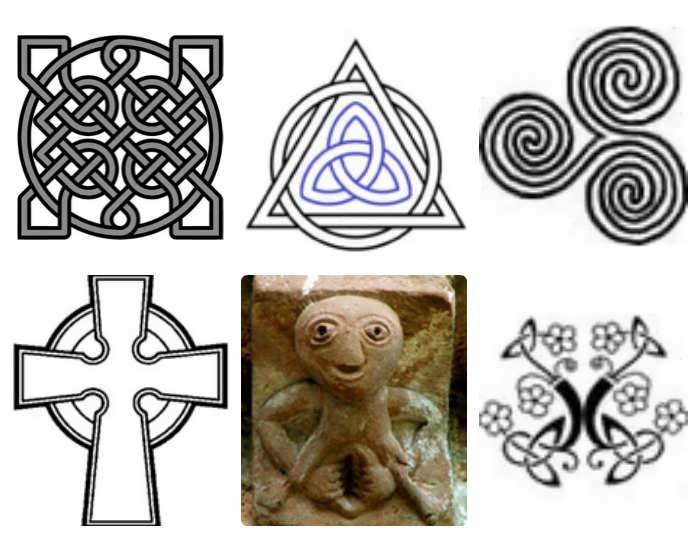
Here are some of the more popular Celtic symbols.
 The triquetra– Its original meaning was simply “triangle,” and it has been used to refer to various three-cornered shapes. Its original meaning was simply “triangle,” and it has been used to refer to various three-cornered shapes. Nowadays, it has come to refer exclusively to a certain, more complicated shape formed of three Vesica Pisces, sometimes with an added circle in or around it. The triquetra is often found in Insular art, most notably metal work and in illuminated manuscripts like the Book of Kells. The fact that the triquetra very rarely stood alone in medieval Celtic has cast a reasonable doubt on its use as a symbol in the context where it was used primarily as a space filler or ornament in much more complex compositions. But Celtic art lives on as both a living folk art tradition and through several revivals. The triquetra– Its original meaning was simply “triangle,” and it has been used to refer to various three-cornered shapes. Its original meaning was simply “triangle,” and it has been used to refer to various three-cornered shapes. Nowadays, it has come to refer exclusively to a certain, more complicated shape formed of three Vesica Pisces, sometimes with an added circle in or around it. The triquetra is often found in Insular art, most notably metal work and in illuminated manuscripts like the Book of Kells. The fact that the triquetra very rarely stood alone in medieval Celtic has cast a reasonable doubt on its use as a symbol in the context where it was used primarily as a space filler or ornament in much more complex compositions. But Celtic art lives on as both a living folk art tradition and through several revivals. |
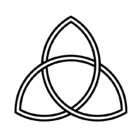 Triquetra is composed exactly of three overlapping Vesica Pisces symbols. Triquetra is composed exactly of three overlapping Vesica Pisces symbols. |
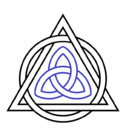 The triquetra is in blue as part of an interlaced Christian Trinitarian decorative symbol. The triquetra is in blue as part of an interlaced Christian Trinitarian decorative symbol. |
|
|
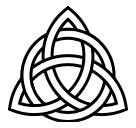 Triquetra is interlaced with a circle as a Christian Trinitarian symbol (a “Trinity Knot”). Triquetra is interlaced with a circle as a Christian Trinitarian symbol (a “Trinity Knot”). |
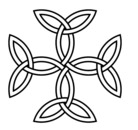 The cross of triquetras or Carolingian Cross. The cross of triquetras or Carolingian Cross. |
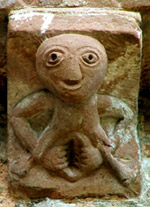 The Sheela Na Gig – The name was first published in the Proceedings of the Royal Irish Academy 1840-44 as a local name for a carving once present on a church gable wall in Rochestown, County Tipperary, Ireland; The name was also recorded in 1840 by John O’Donovan, an official of the Ordnance Survey of Ireland, referring to a figure on a church in Kiltinane, County Tipperary. There is controversy regarding the origin and meaning of the name, as the name is not directly translatable into Irish. Alternative spellings of “Sheela” may sometimes be encountered; they include Sheila, Síle, and Síla. The name “Seán-Na-Gig” was coined by Jack Roberts for the ithyphallic male counterpart of the Sheela, which is fairly rare in Ireland but is much more common on the continent. The Sheela Na Gig is a fertility figure. The Sheela Na Gig – The name was first published in the Proceedings of the Royal Irish Academy 1840-44 as a local name for a carving once present on a church gable wall in Rochestown, County Tipperary, Ireland; The name was also recorded in 1840 by John O’Donovan, an official of the Ordnance Survey of Ireland, referring to a figure on a church in Kiltinane, County Tipperary. There is controversy regarding the origin and meaning of the name, as the name is not directly translatable into Irish. Alternative spellings of “Sheela” may sometimes be encountered; they include Sheila, Síle, and Síla. The name “Seán-Na-Gig” was coined by Jack Roberts for the ithyphallic male counterpart of the Sheela, which is fairly rare in Ireland but is much more common on the continent. The Sheela Na Gig is a fertility figure. |
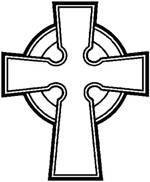 A Celtic cross is a symbol that combines a cross with a ring surrounding the intersection. The symbol is associated with Celtic Christianity, although it has older, pre-Christian origins. Such crosses form a major part of Celtic art. A standing Celtic cross, made of stone and often richly ornamented, is called a high cross or Irish Cross. Celtic crosses may have had origins in the early Coptic church. A Celtic cross is a symbol that combines a cross with a ring surrounding the intersection. The symbol is associated with Celtic Christianity, although it has older, pre-Christian origins. Such crosses form a major part of Celtic art. A standing Celtic cross, made of stone and often richly ornamented, is called a high cross or Irish Cross. Celtic crosses may have had origins in the early Coptic church.In Ireland, it is a popular myth that the Celtic cross was introduced by Saint Patrick or possibly Saint Declan during his time converting the pagan Irish. |
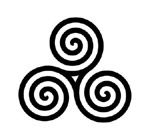 The triple spiral or triskele is a Celtic and pre-Celtic symbol found on a number of Irish Megalithic and Neolithic sites, most notably inside the Newgrange passage tomb, on the entrance stone, and on some of the curbstones surrounding the mound.Believed by many to be an ancient symbol of pre-Celtic and Celtic beliefs, the triple spiral appears in various forms in pre-Celtic and Celtic art, with the earliest examples having been carved on pre-Celtic stone monuments and later examples found in the Celtic Christian illuminated manuscripts of Insular art. The triple spiral was possibly the precursor to the later triskele design found in the manuscripts. The triple spiral or triskele is a Celtic and pre-Celtic symbol found on a number of Irish Megalithic and Neolithic sites, most notably inside the Newgrange passage tomb, on the entrance stone, and on some of the curbstones surrounding the mound.Believed by many to be an ancient symbol of pre-Celtic and Celtic beliefs, the triple spiral appears in various forms in pre-Celtic and Celtic art, with the earliest examples having been carved on pre-Celtic stone monuments and later examples found in the Celtic Christian illuminated manuscripts of Insular art. The triple spiral was possibly the precursor to the later triskele design found in the manuscripts. |
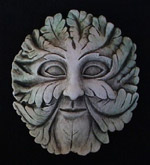 The Green Man is often perceived as an ancient Celtic symbol. In Celtic mythology, he is a god of spring and summer. He disappears and returns year after year, century after century, enacting themes of death and resurrection, the ebb and flow of life and creativity. The Arthurian legend of Sir Gawain, The Green Knight, is a notable image of the Green Man from the Middle Ages. Gawain had a green helmet, green armour, green shield… even a green horse. When he was decapitated, he continued to live. The Green Man is often perceived as an ancient Celtic symbol. In Celtic mythology, he is a god of spring and summer. He disappears and returns year after year, century after century, enacting themes of death and resurrection, the ebb and flow of life and creativity. The Arthurian legend of Sir Gawain, The Green Knight, is a notable image of the Green Man from the Middle Ages. Gawain had a green helmet, green armour, green shield… even a green horse. When he was decapitated, he continued to live. |
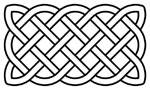 The Celtic Knot – Celtic knots are a variety of (mostly endless) knots and stylized graphical representations of knots used for decoration, adopted by the ancient Celts. These knots are most known for their adaptation for use in the ornamentation of Christian monuments and manuscripts like the 8th-century Book of Kells and the Lindisfarne Gospels. The Celtic Knot – Celtic knots are a variety of (mostly endless) knots and stylized graphical representations of knots used for decoration, adopted by the ancient Celts. These knots are most known for their adaptation for use in the ornamentation of Christian monuments and manuscripts like the 8th-century Book of Kells and the Lindisfarne Gospels.There is no evidence to indicate that a knot had any specific philosophical or religious significance beyond perhaps the most obvious, that being the intricacy capable in the work of humans, itself reflective of the intricacy of Natural forms. |
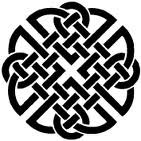 Dara Celtic Knot -The meaning of the word ‘Dara’ can be traced to an Irish word, Doire, which means ‘oak tree.’ The Dara Celtic knot is associated with the root system of oak trees. The Celtics, and especially Druids, considered the oak tree sacred. They used to derive meaningful messages applicable to day-to-day life through the language of trees. Oaktree is the symbol of destiny, power, strength, wisdom, leadership, and endurance. All these attributes, therefore, are associated with the Dara Celtic knot. The roots of the oak tree, represented in the form of a Dara Celtic knot, are symbolic of the great source of inner strength or divine resources we possess. Dara Celtic Knot -The meaning of the word ‘Dara’ can be traced to an Irish word, Doire, which means ‘oak tree.’ The Dara Celtic knot is associated with the root system of oak trees. The Celtics, and especially Druids, considered the oak tree sacred. They used to derive meaningful messages applicable to day-to-day life through the language of trees. Oaktree is the symbol of destiny, power, strength, wisdom, leadership, and endurance. All these attributes, therefore, are associated with the Dara Celtic knot. The roots of the oak tree, represented in the form of a Dara Celtic knot, are symbolic of the great source of inner strength or divine resources we possess. |
 Quaternary Celtic Knot – The task of tracking down the exact meaning of Celtic symbols is difficult due to the lack of concrete proofs or writings. In many cases, one has to rely on the artist’s interpretation of a particular symbol. The quaternary knot symbol could, thus, depict or indicate four directions (East, West, North, and South). The symbol could also mean four elements of nature, i.e. Earth, Fire, Water and Air. The fire festivals of Celts, i.e. Samhain, Beltane, Imbolc, and Lughnasadh, could also be an interpretation of the quaternary symbol. The quaternary symbol could also be an indication of Tuatha’s treasures. Quaternary Celtic Knot – The task of tracking down the exact meaning of Celtic symbols is difficult due to the lack of concrete proofs or writings. In many cases, one has to rely on the artist’s interpretation of a particular symbol. The quaternary knot symbol could, thus, depict or indicate four directions (East, West, North, and South). The symbol could also mean four elements of nature, i.e. Earth, Fire, Water and Air. The fire festivals of Celts, i.e. Samhain, Beltane, Imbolc, and Lughnasadh, could also be an interpretation of the quaternary symbol. The quaternary symbol could also be an indication of Tuatha’s treasures. |
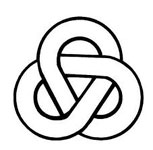 The Eternity Knot – could be any of the Celtic knot design patterns that have a closed path. It means that such Celtic knots neither have a beginning nor an end. George Bain, a Celtic art teacher from Scotland, attributed this meaning to the eternity knot. The Eternity Knot – could be any of the Celtic knot design patterns that have a closed path. It means that such Celtic knots neither have a beginning nor an end. George Bain, a Celtic art teacher from Scotland, attributed this meaning to the eternity knot. |
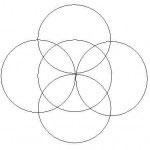 Five-Fold Symbol – Like the Arwen, the five-fold symbol also represented a balance of human nature. Many experts who have studied Celtic symbols and meanings claim that this symbol represents the five basic elements of the universe: fire, water, sun, earth, and air. Some experts, however, believe that the middle fold is the universe, surrounded by fire, water, earth, and air. Five-Fold Symbol – Like the Arwen, the five-fold symbol also represented a balance of human nature. Many experts who have studied Celtic symbols and meanings claim that this symbol represents the five basic elements of the universe: fire, water, sun, earth, and air. Some experts, however, believe that the middle fold is the universe, surrounded by fire, water, earth, and air. |
 Arwen – The Arwen, also known as the symbol of three rays, symbolized the balance between male and female energy. The Arwen, with three rays that were parallel to each other, was often used in jewelry. The first and last rays signified the powers of the ‘male’ and ‘female,’ respectively. The middle ray signified the balance and equality of the other rays. Most experts on Celtic symbols and meanings have interpreted the Arwen as a symbol that implies a balance between two opposing powers in the universe. Arwen – The Arwen, also known as the symbol of three rays, symbolized the balance between male and female energy. The Arwen, with three rays that were parallel to each other, was often used in jewelry. The first and last rays signified the powers of the ‘male’ and ‘female,’ respectively. The middle ray signified the balance and equality of the other rays. Most experts on Celtic symbols and meanings have interpreted the Arwen as a symbol that implies a balance between two opposing powers in the universe. |
 Single Spiral – The single spiral is one of the most common symbols of the Celtic culture. The spiral was actually the figure that had the spiral folds of the same line. This symbol stood for the radiation of ethereal energy. There are, however, many different meanings of the single spiral. Some of the most prominent ones are birth, growth, and death, or expansion of the consciousness, its perseverance, and knowledge. Single Spiral – The single spiral is one of the most common symbols of the Celtic culture. The spiral was actually the figure that had the spiral folds of the same line. This symbol stood for the radiation of ethereal energy. There are, however, many different meanings of the single spiral. Some of the most prominent ones are birth, growth, and death, or expansion of the consciousness, its perseverance, and knowledge. |
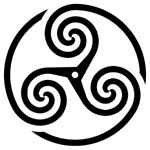 Triskelion – The Triskelion was a prominent Celtic symbol that represented the concept of completion and progress. The symbol looked like a three-legged wheel. According to the first derivation of the meaning, the triskelion represents actions, cycles, progress, revolution, and competition. In all, the triskelion was a representation of a sense of advancement. Triskelion – The Triskelion was a prominent Celtic symbol that represented the concept of completion and progress. The symbol looked like a three-legged wheel. According to the first derivation of the meaning, the triskelion represents actions, cycles, progress, revolution, and competition. In all, the triskelion was a representation of a sense of advancement. |
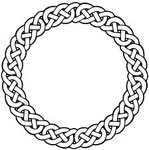 Circular Knots – As the name suggests, these knots are circular in shape, emphasizing the continuity of life or eternity. Some interpret it as standing for the infinite quality of some object or attribute, whereas others consider it as emphasizing the ‘endless’ quality. It is for this reason that this Celtic knot is very commonly seen in wedding rings or other gifts exchanged between lovers that emphasize the endless nature of their emotions for each other. Circular Knots – As the name suggests, these knots are circular in shape, emphasizing the continuity of life or eternity. Some interpret it as standing for the infinite quality of some object or attribute, whereas others consider it as emphasizing the ‘endless’ quality. It is for this reason that this Celtic knot is very commonly seen in wedding rings or other gifts exchanged between lovers that emphasize the endless nature of their emotions for each other. |
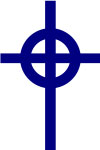 Celtic Cross – A Celtic cross is a symbol that combines a cross with a ring surrounding the intersection. In the Celtic Christian world, it was combined with the Christian cross, and this design was often used for high crosses – a free-standing cross made of stone and often richly decorated. With the Celtic Revival, the shape, usually decorated with interlace and other motifs from Insular art, became popular for funerary monuments and other uses and has remained so, spreading well beyond the British Isles. Celtic Cross – A Celtic cross is a symbol that combines a cross with a ring surrounding the intersection. In the Celtic Christian world, it was combined with the Christian cross, and this design was often used for high crosses – a free-standing cross made of stone and often richly decorated. With the Celtic Revival, the shape, usually decorated with interlace and other motifs from Insular art, became popular for funerary monuments and other uses and has remained so, spreading well beyond the British Isles.
In Ireland, it is a popular legend that the Celtic Catholic cross was introduced by Saint Patrick or possibly Saint Declan during his time converting the pagan Irish, though no examples survive from this early period. It has often been claimed that Patrick combined the symbol of Christianity with the sun cross to give pagan followers an idea of the importance of the cross by linking it with the idea of the life-giving properties of the sun. However, most art historians think this theory is now unlikely and think an origin from crosses carrying Victor’s wreath around their intersection is more likely. Such a cross is found on the reverse of the Liudhard medalet from Canterbury in England in the 590s. |
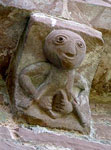 Sheela Na Gigs are figurative carvings of naked women displaying an exaggerated vulva. They are found in churches, castles and other buildings, particularly in Ireland and Britain, sometimes together with male figures. The Sheelas were used as protective devices and were considered lucky. One of the best examples may be found in the Round Tower at Rattoo, in County Kerry, Ireland. A replica is located in the County Museum in Tralee town. Another well-known example can be seen at Kilpeck in Herefordshire, England.There is controversy regarding the source of the figures. One perspective, by James Jerman and Anthony Weir, is that the Sheelas were first carved in France and Spain in the 11th century; the motif eventually reached Britain and then Ireland in the 12th century. Sheela Na Gigs are figurative carvings of naked women displaying an exaggerated vulva. They are found in churches, castles and other buildings, particularly in Ireland and Britain, sometimes together with male figures. The Sheelas were used as protective devices and were considered lucky. One of the best examples may be found in the Round Tower at Rattoo, in County Kerry, Ireland. A replica is located in the County Museum in Tralee town. Another well-known example can be seen at Kilpeck in Herefordshire, England.There is controversy regarding the source of the figures. One perspective, by James Jerman and Anthony Weir, is that the Sheelas were first carved in France and Spain in the 11th century; the motif eventually reached Britain and then Ireland in the 12th century.
The idea that Sheela Na Gigs represents a pagan goddess is a popular theory with the public; it is, however, not generally accepted by academics. The goddess in question is usually identified as Celtic, the hag-like Cailleach figure of Irish and Scottish mythology. |
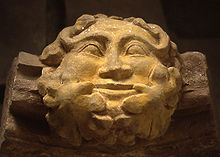 A Green Man is a sculpture, drawing, or other representation of a face surrounded by or made from leaves. Branches or vines may sprout from the nose, mouth, nostrils or other parts of the face, and these shoots may bear flowers or fruit. Commonly used as a decorative architectural ornament, Green Men are frequently found on carvings in churches and other buildings (both secular and ecclesiastical). “The Green Man” is also a popular name for English public houses, and various interpretations of the name appear on inn signs, which sometimes show a full figure rather than just the head.The Green Man motif has many variations. Found in many cultures around the world, the Green Man is often related to natural vegetative deities springing up in different cultures throughout the ages. Primarily it is interpreted as a symbol of rebirth, or “renaissance,” representing the cycle of growth each spring. Some speculate that the mythology of the Green Man developed independently in the traditions of separate ancient cultures and evolved into the wide variety of examples found throughout history. A Green Man is a sculpture, drawing, or other representation of a face surrounded by or made from leaves. Branches or vines may sprout from the nose, mouth, nostrils or other parts of the face, and these shoots may bear flowers or fruit. Commonly used as a decorative architectural ornament, Green Men are frequently found on carvings in churches and other buildings (both secular and ecclesiastical). “The Green Man” is also a popular name for English public houses, and various interpretations of the name appear on inn signs, which sometimes show a full figure rather than just the head.The Green Man motif has many variations. Found in many cultures around the world, the Green Man is often related to natural vegetative deities springing up in different cultures throughout the ages. Primarily it is interpreted as a symbol of rebirth, or “renaissance,” representing the cycle of growth each spring. Some speculate that the mythology of the Green Man developed independently in the traditions of separate ancient cultures and evolved into the wide variety of examples found throughout history. |
 Ailm is the Celtic symbol of purity that is found in the Ogham. A primeval form of communication in the Celtic culture, the Ogham is a realm of trees that were believed to lend knowledge and wisdom to the seeker. Ailm symbolizes pure energy, integrity, objectivity, clarity, strength and good health.Its symbol represents the branches of the fir tree, one of the nine sacred pieces of wood used for sabbat fire. This evergreen tree that grows tall & straight and survives through challenging conditions is representative of strength, resilience, endurance, longevity, friendship, honesty, truth and perceptiveness. Ailm is the Celtic symbol of purity that is found in the Ogham. A primeval form of communication in the Celtic culture, the Ogham is a realm of trees that were believed to lend knowledge and wisdom to the seeker. Ailm symbolizes pure energy, integrity, objectivity, clarity, strength and good health.Its symbol represents the branches of the fir tree, one of the nine sacred pieces of wood used for sabbat fire. This evergreen tree that grows tall & straight and survives through challenging conditions is representative of strength, resilience, endurance, longevity, friendship, honesty, truth and perceptiveness.
The circle in the Ailm symbol is a Celtic sign that denotes the wholeness, intactness, and purity of the soul. |
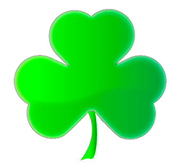 Shamrock – Found growing abundantly throughout the hillsides of Ireland, the Shamrock or Clover is arguably the country’s most famous symbol. It is closely associated with St. Patrick, who used it to teach people the Christian concept of the Holy Trinity of the Father, the Son, and the Holy Ghost. So, the Shamrock came to be highly revered by the ancient Celtics as a symbol of Christianity, faith, hope, love and spiritual development. Due to its prolific growth, it is considered to be representative of abundance, nurturing, fertility, productivity, and stability. The Shamrock is credited with mystic powers as its petals stand up when a storm is approaching, warning people of the impending danger. Therefore, it is also used as a charm for bringing good luck and warding off evil. Shamrock – Found growing abundantly throughout the hillsides of Ireland, the Shamrock or Clover is arguably the country’s most famous symbol. It is closely associated with St. Patrick, who used it to teach people the Christian concept of the Holy Trinity of the Father, the Son, and the Holy Ghost. So, the Shamrock came to be highly revered by the ancient Celtics as a symbol of Christianity, faith, hope, love and spiritual development. Due to its prolific growth, it is considered to be representative of abundance, nurturing, fertility, productivity, and stability. The Shamrock is credited with mystic powers as its petals stand up when a storm is approaching, warning people of the impending danger. Therefore, it is also used as a charm for bringing good luck and warding off evil. |
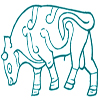 Celtic Bull – The Bull had a critical role in Druid sacrificial rituals, particularly the prophetic ones. The symbol of God Esus, this revered animal has held diverse significance in the Celtic world. It was considered the symbol of uncompromising, stubborn and strong will. The Celts have also long associated the bull with sovereignty, wealth, status, abundance, virility and fertility. Additionally, it represented kinship, ancestry and close ties with the land. In ancient Ireland, a new High King’s crowning was always preceded by a ritualistic feast of bull. For a Celtic clan or village, a good bull represented its prosperity and high prestige. Celtic Bull – The Bull had a critical role in Druid sacrificial rituals, particularly the prophetic ones. The symbol of God Esus, this revered animal has held diverse significance in the Celtic world. It was considered the symbol of uncompromising, stubborn and strong will. The Celts have also long associated the bull with sovereignty, wealth, status, abundance, virility and fertility. Additionally, it represented kinship, ancestry and close ties with the land. In ancient Ireland, a new High King’s crowning was always preceded by a ritualistic feast of bull. For a Celtic clan or village, a good bull represented its prosperity and high prestige. |