The earliest known writing discovered in the Mayan script dates from about 250 BC, but the script is thought to have developed at an earlier date than that. The Mayans were known for their sophisticated culture which included many hieroglyphics.
Mayan hieroglyphics were carved into stone or bone or even painted on pottery or written on books. The two main topics of their texts were astronomy and religious views.
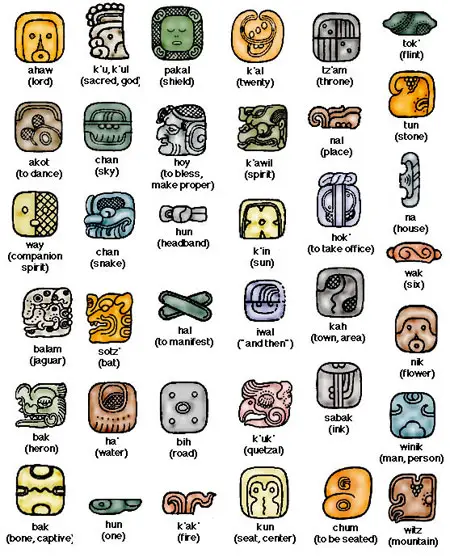
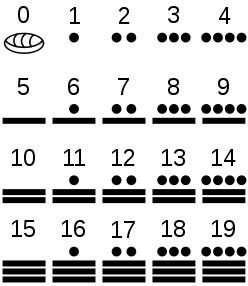
The main logograms the Mayan civilization used to express words and ideas.
There are many ancient Mayan symbols; we have added some of the most popular below.
 |
|
|
Here are the Ancient Mayan symbols for the numbers 0 through 10. |
|
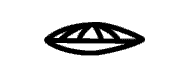 Zero Zero |
 One One |
 Two Two |
 Three Three |
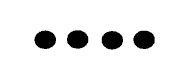 Four Four |
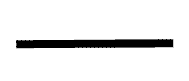 Five Five |
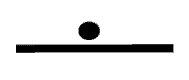 Six Six |
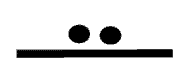 Seven Seven |
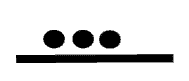 Eight Eight |
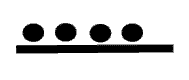 Nine Nine |
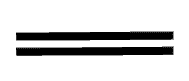 Ten Ten |
|
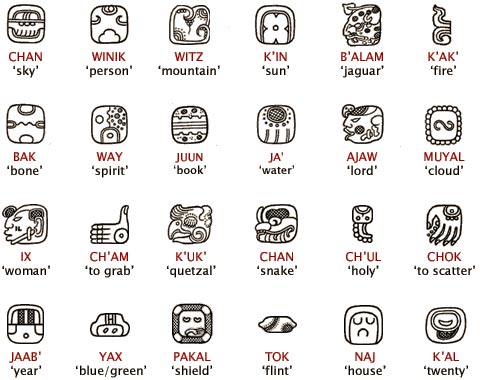
Maya numerals were a vigesimal (base-twenty) numeral system used by the pre-Columbian Maya civilization.
The numerals are made up of three symbols: zero (shell shape), one (a dot) and five (a bar). For example, nineteen (19) is written as four dots in a horizontal row above three horizontal lines stacked upon each other.
Here is the chart of Mayan numerals.
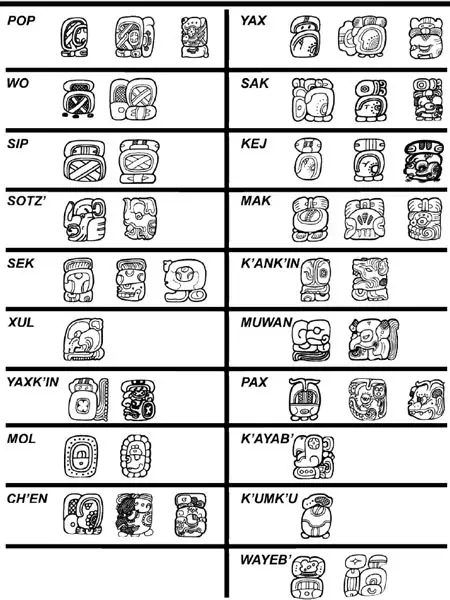
The Haab was the Maya solar calendar made up of eighteen months of twenty days each plus a period of five days (“nameless days”) at the end of the year known as Wayeb’ (or Uayeb in 16th C. orthography).
Each day in the Haab calendar was identified by a day number in the month, followed by the month’s name. Day numbers began with a glyph translated as the “seating of” a named month, which is usually regarded as day 0 of that month, although a minority treat it as day 20 of the month preceding the named month. In the latter case, the seating of Pop is day 5 of Wayeb’s. For the majority, the first day of the year was 0 Pop (the seating of Pop). This was followed by 1 Pop, 2 Pop as far as 19 Pop, then 0 Wo, 1 Wo and so on.
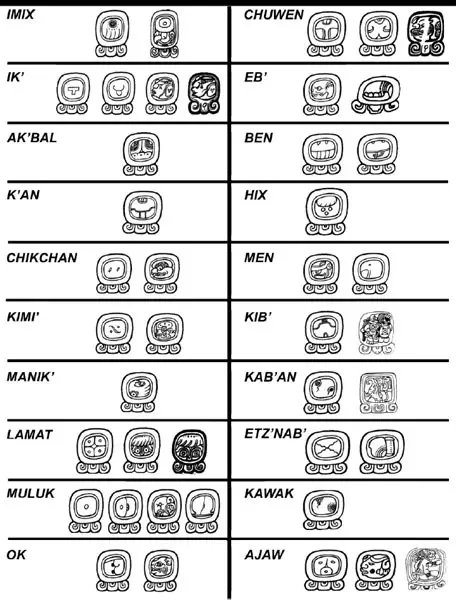
Neither the Tzolk’in nor the Haab’ system numbered the years. Combining a Tzolk’in date and a Haab’ date was enough to identify a date to most people’s satisfaction, as such a combination did not occur again for another 52 years, above general life expectancy.
Because the two calendars were based on 260 days and 365 days, respectively, the whole cycle would repeat itself every 52 Haab years exactly. This period was known as a Calendar Round. The end of the Calendar Round was a period of unrest and bad luck among the Mayans, as they waited in expectation of seeing if the gods would grant them another cycle of 52 years.
Here is the Haab calendar (365 days):
Here is the Mayan sacred almanac of 260 days:
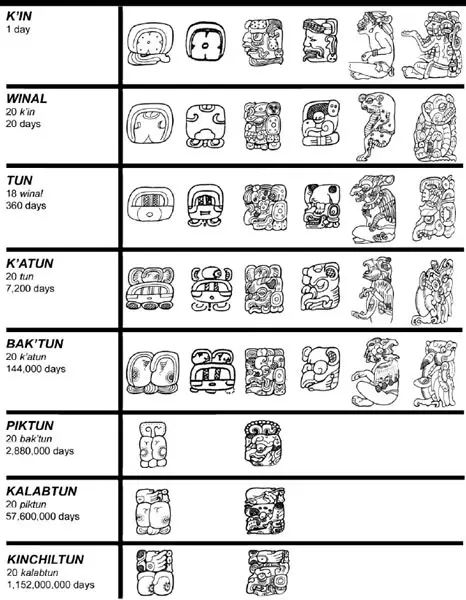
The Mesoamerican Long Count calendar is a non-repeating, vigesimal (base-20) and base-18 calendar used by several Pre-Columbian Mesoamerican cultures, most notably the Maya. For this reason, it is sometimes known as the Maya (or Mayan) Long Count calendar. Using a modified vigesimal tally, the Long Count calendar identifies a day by counting the days passed since a mythical creation date corresponding to August 11, 3114 BCE in the Gregorian calendar.
The Long Count calendar was widely used on monuments.
Here is the Mayan Long Count Calendar and its symbols:
.
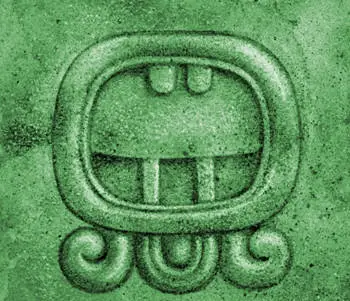
Caban
This ancient Mayan symbol is representative of the Earthkeeper who sanctifies the Earth and venerates all life that exists on it. Reminding everyone of the larger forces that are behind all creation, this Earth symbol represents movement, transition, and synchronization. It motivates people to be patient, observant and flexible. It also symbolizes the synergistic working of destiny that brings everyone together for shared spiritual intents. Focusing on the Caban symbol helps one become centred and experience spiritual unfolding.
These are the main Mayan symbols that we have discovered to this date. If more Mayan symbols should be found and documented, we will include them in this section on ancient Mayan symbols.
Jaguar
The Jaguar is the god of the underworld in Mayan mythology and is symbolic of darkness and the night sun. It rules over the celestial forces of day & night and so is seen as a representation of leadership, control, and confidence.
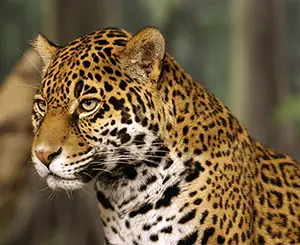
Being the embodiment of aggression, the Jaguar is also a symbol of strength, ferocity, power, and valour. It has a strong vision and can see even at night. So, it is associated with deep perception, foresight, and prudence. The ancient Mayans revered the Jaguar and accorded it immense religious importance, second only to the snake god.
Eagle
 The Eagle represents focus, mental acuity, contemplative thought, sharp awareness, foresight, keen judgment, powerful communication, and inspiration. Focusing on it is believed to facilitate clear thinking, give access to inner wisdom and encourage action that takes one to greater heights in life. Seen as the ruler of the sky, the Eagle is associated with freedom, mental liberation, and detail-oriented vision.
The Mayan symbol of the Eagle also stands for protection, authority, and control and is considered symbolic of unity or cooperation within a diverse group. Native wisdom relates the Eagle with skill and determination because of its ability to fulfill its needs in the most efficient way.