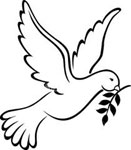
 Dove and Olive Branch Dove and Olive Branch
The dove and olive branch was used by early Christians and became current in the 18th century. It was popularised by the artist Pablo Picasso in 1949 and became widely used in the post-war peace movement. The dove represents the Holy Spirit or Holy Ghost. |
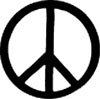 Peace Sign Peace Sign
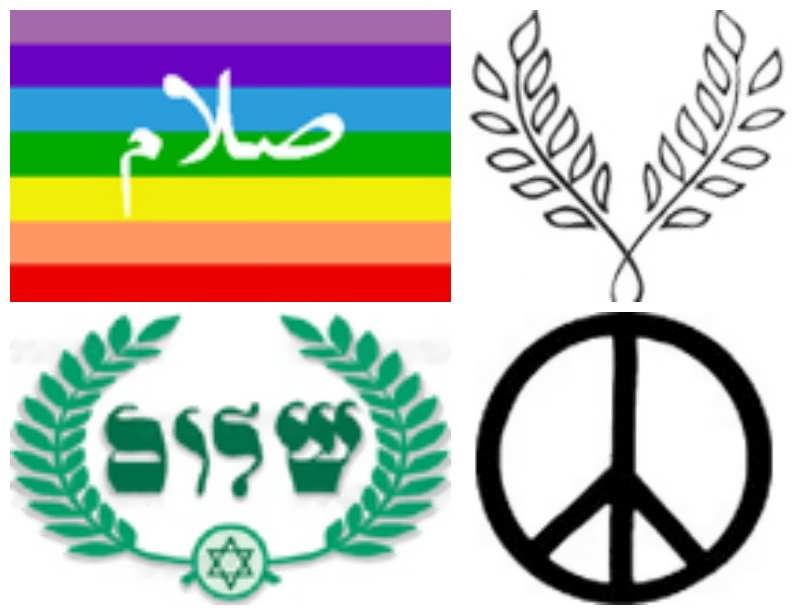
The anti-nuclear emblem or the peace sign is one of the most widely known symbols in the world. It was invented at the request of Lord Bertrand Russel, head of the British ‘campaign for nuclear disarmament’ or CDN and sponsor of mass marches and sit-downs in London. The symbol is a combination of the semaphore signals for the letters “N” and “D,” standing for “nuclear disarmament.” |
 Pax Cultura Emblem Pax Cultura Emblem
Nicholas Roerich (1874–1947) founded a movement to protect cultural artifacts, whose symbol, a maroon-on-white emblem consisting of three solid circles in a surrounding circle, has been used as a peace banner. In 1935 a pact initiated by Roerich was signed by the United States and Latin American nations, agreeing that “historical monuments, museums, scientific, artistic, educational and cultural institutions” should be protected both in times of peace and war. The Roerich Museum says, “The Banner of Peace symbol has ancient origins. Perhaps its earliest known example appears on Stone Age amulets: three dots without the enclosing circle. Roerich came across numerous later examples in various parts of the world and knew that it represented a deep and sophisticated understanding of the triune nature of existence. But for the Banner and the Pact, Roerich described the circle as representing the totality of culture, with the three dots being Art, Science, and Religion, three of the most embracing of human cultural activities. He also described the circle as representing the eternity of time, encompassing the past, present, and future. |
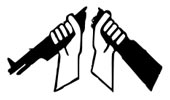 Broken Rifle Symbol Broken Rifle Symbol
War Resisters’ International (WRI) and its affiliates use the broken rifle symbol but predate the foundation of WRI in 1921. The first known example of the symbol is in the masthead of the January 1909 issue of De Wapens Neder (Down With Weapons), the monthly paper of the International Antimilitarist Union in the Netherlands. |
White Poppy
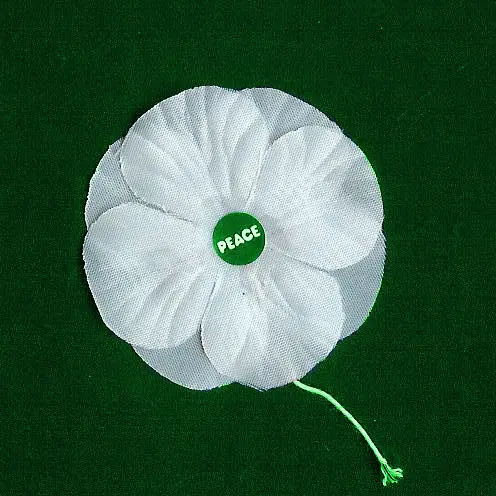
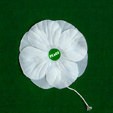 The White Poppy is a symbol of peace that advocates ending wars and is worn to remember the military and civilian casualties of wars. It represents the belief that killing strangers is not the best way of resolving conflicts. An artificial white poppy flower is worn either as an alternative to or as a complement to the red poppy that is worn on Remembrance Day to commemorate the war dead. The symbol was introduced in 1933 by the Women’s Co-operative Guild of the UK, and in 1934, newly-formed peace organization, Peace Pledge Union (PPU) joined the movement. Presently, the PPU runs the White Poppy Appeal. The White Poppy is a symbol of peace that advocates ending wars and is worn to remember the military and civilian casualties of wars. It represents the belief that killing strangers is not the best way of resolving conflicts. An artificial white poppy flower is worn either as an alternative to or as a complement to the red poppy that is worn on Remembrance Day to commemorate the war dead. The symbol was introduced in 1933 by the Women’s Co-operative Guild of the UK, and in 1934, newly-formed peace organization, Peace Pledge Union (PPU) joined the movement. Presently, the PPU runs the White Poppy Appeal.
|
 Peace Flag Peace Flag
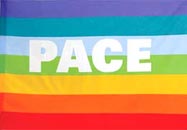
This rainbow flag originated in Italy and is boldly emblazoned with the Italian word PACE, meaning ‘peace.’ The international peace flag in the colours of the rainbow was first used in Italy on a 1961 peace march from Perugia to Assisi organized by the pacifist and social philosopher Aldo Capitini (1899–1968). Inspired by the peace flags used on British peace marches, Capitini hurriedly got some Perugia women to sew together coloured strips of material. |
 Peace Crane Peace Crane
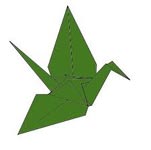
Within Asia, the white crane is the bird of peace. Initially, it was the sort of peace that comes with prosperity and friendship, such that war is not even considered. The crane took on even greater significance as a peace symbol within Japan right after the bombings of Hiroshima and Nagasaki. |
 Peace Hand Gesture Peace Hand Gesture
The peace hand gesture is thought to have begun in Europe during World War II when a V for victory – and not to be confused with the Catholic gesture of benediction – was painted on walls as a symbol of freedom from occupying forces. Peace movements widely used the sign in the 1960s and 1970s as a symbol of victory for peace and truth. |
 Olive Branch Olive Branch
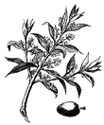
The Olive Branch has been used as a sign of peace in western civilization for ages and has even been found in different religions and cultures that thrived in the Mediterranean. This peace symbol is believed to have originated from ancient Greek customs. While the Greeks considered the olive tree to represent abundance, they also believed it to have the power to ward off evil spirits. In Greek mythology, the Olive Branch is shown to be one of the key attributes of Eirene, the Goddess of Peace. |