People all around the world know many Egyptian symbols when they see them. They seem almost magical, and people are captivated by their beauty and significance. Many Egyptian symbols were depicted in hieroglyphs, these symbols were often called “The words of God”, and these symbols were commonly used by priests.
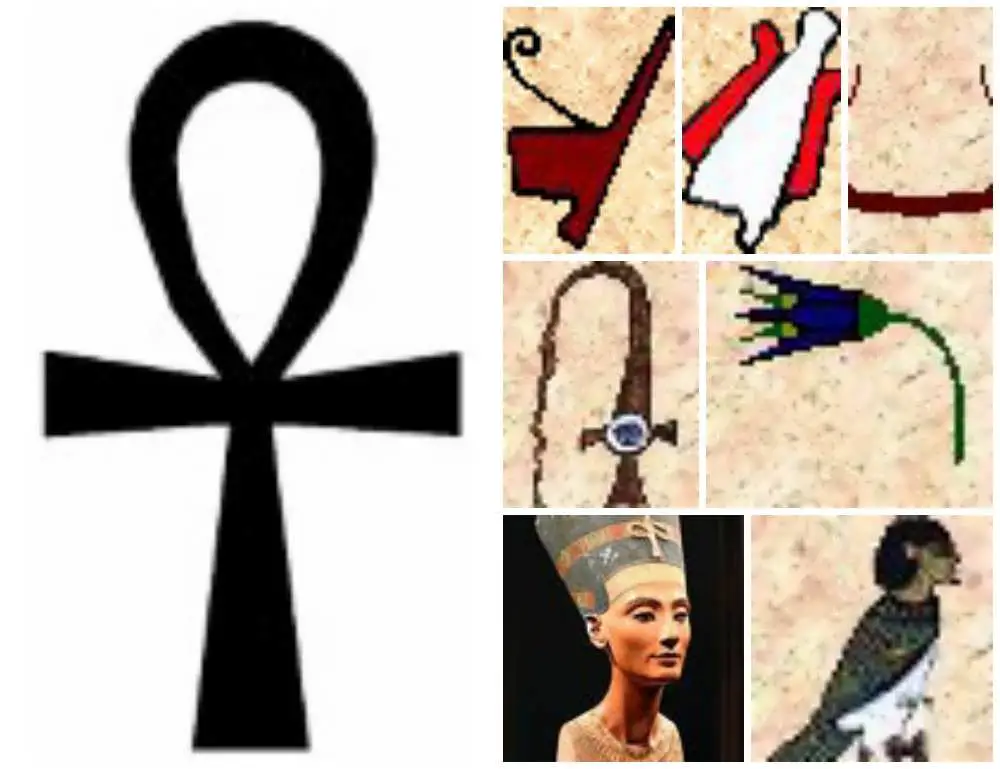
There are many ancient Egyptian symbols depicted throughout Egypt. This section of our website covers many of the most popular ancient Egyptian symbols. Many ancient Egyptian symbols were used as amulets of protection, or they were used to bring good fortune. Many ancient Egyptian symbols were also used in religious and magical rituals for the living and also for the dead.
 Ba BaThe Ba is what we might call someone’s personality. It would leave the body at the time of death. During the days the Ba would make itself useful, at night it would return to the tomb. At this time, it would look for the person to whom it belonged. This would be the mummy; however, often the Egyptians would supply the Ba with a statue in the likeness of the deceased in case the mummy was lost or damaged. |  Amenta Amenta
This symbol represents the Underworld or Land of the Dead. Originally it meant the horizon of the sunset. Later, it became the symbol of the west bank of the Nile, where the sunset and also where the Egyptians traditionally buried their dead. Egyptian Cartouche |
 Uraeus Uraeus
The cobra is an emblem of Lower Egypt. It is associated with the king and kingdom of Lower Egypt. It is also associated with the sun and with many deities. The cobra represented the “fiery eye of Re”, in which two uraei can be seen on either side of a winged solar disk. Starting in the Middle Kingdom, The uraeus appears as a symbol worn on the crown or headdress of royalty. It is used as a protective symbol; the Egyptians believed that the cobra would spit fire at any approaching enemies. The Uraeus is a symbol for the goddess Wadjet, one of the earliest of Egyptian deities, who often was depicted as a cobra. The center of her cult was in Per-Wadjet, later called Buto by the Greeks. She became the patroness of the Nile Delta and the protector of all of Lower Egypt, so her image was worn by the pharaohs as a head ornament, first as the body of Wadjet atop the head or as a crown encircling the head, always remaining in effect part of their crown, indicating her protection and as a claim over the land. The pharaoh was recognized only by wearing the uraeus, which conveyed legitimacy to the ruler. |  Deshret Deshret
The Red Crown. This was the crown that represented Lower Egypt (northern). |
 Nemes Nemes
A striped headcloth wore by Pharaohs. |  Was Was
This is a symbol of power and dominion. The Was scepter is carried by deities as a sign of their power. It is also seen being carried by kings and later by people of lesser stature in mortuary scenes |
 Hedjet Hedjet
The White Crown. This was the crown of Upper Egypt (southern). |  Shenu Shenu
More commonly known as a cartouche. The shape represents a loop of rope in which a name is written. A protector of that name. |
| Uraeus
The cobra is an emblem of Lower Egypt. It is associated with the king and kingdom of Lower Egypt. It is also associated with the sun and with many deities. The cobra represented the “fiery eye of Re”, in which two uraei can be seen on either side of a winged solar disk. Starting in the Middle Kingdom, The uraeus appears as a symbol worn on the crown or headdress of royalty. It is used as a protective symbol; the Egyptians believed that the cobra would spit fire at any approaching enemies. The Uraeus is a symbol for the goddess Wadjet, one of the earliest of Egyptian deities, who often was depicted as a cobra. The center of her cult was in Per-Wadjet, later called Buto by the Greeks. She became the patroness of the Nile Delta and the protector of all of Lower Egypt, so her image was worn by the pharaohs as a head ornament, first as the body of Wadjet atop the head or as a crown encircling the head, always remaining in effect part of their crown, indicating her protection and as a claim over the land. The pharaoh was recognized only by wearing the uraeus, which conveyed legitimacy to the ruler. |  Djed Djed
It is believed that the Djed is a rendering of a human backbone. It represents stability and strength. It was initially associated with the creator god Ptah. He is called the “Noble Djed”. As the Osiris cults took hold it became known as the backbone of Osiris. A djed column is often painted on the bottom of coffins, where the backbone of the deceased would lay, this identified the person with the king of the underworld, Osiris. It also acts as a sign of stability for the deceased’ journey into the afterlife. |
 Scarab Scarab
Called the dung beetle because of its practice of rolling a ball of dung across the ground. The Egyptians observed this behavior and equated it with the ball of the sun being rolled across the sky. They confused this balled food source with the egg sack that the female dung beetle laid and buried in the sand. When the eggs hatched the dung beetles would seem to appear from nowhere, making it a symbol of spontaneous creation. In this role, it was associated with the sunrise. Khepri was the scarab-headed god. 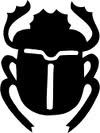 |  Feather of Maat Feather of Maat
Represents truth, justice, morality, and balance. It was the pharaoh’s job to uphold Maat. When a pharaoh died, Maat was lost and the world was flung into chaos, only the coronation of a new pharaoh could restore Maat. |
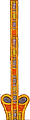 Sema Sema
Sema is a rendering of the lungs attached to the windpipe. As a hieroglyph, this symbol represents the unification of Upper and Lower Egypt. Other symbols are often added to illustrate unification further. | Feather of Maat
Represents truth, justice, morality, and balance. It was pharaoh’s job to uphold Maat. When a pharaoh died, Maat was lost and the world was flung into chaos, only the coronation of a new pharaoh could restore Maat. |
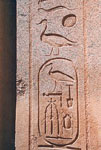 In Egyptian hieroglyphs, a cartouche is a rectangle with a horizontal line at one end, indicating that the text enclosed is a royal name, coming into use during the beginning of the Fourth Dynasty under Pharaoh Sneferu, replacing the earlier serekh. The name cartouche was first applied by soldiers who fancied that the symbol they saw so frequently repeated on the pharaonic ruins they encountered resembled a muzzle-loading firearm’s paper powder cartridge, (cartouche in French).
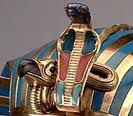 The Uraeus used as a symbol of sovereignty, royalty, deity, and divine authority in ancient Egypt.
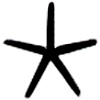 Seba SebaSeba is the Egyptian symbol for a star. This simple line drawing made of 5 equidistant spokes resembles a starfish. The term ‘seba’ means discipline or learning and it is associated with gates and doorways. The early Egyptians had a great interest in an extensive knowledge of the star-filled night sky. The stars had a great deal of influence on the development of their calendar and also dictated their beliefs in life after death. The ceilings of their temples were decorated with images of astral deities, constellations, and stars. The Egyptian sky goddess, Nut is also shown adorned with five-pointed stars. The stars were supposed to represent the souls of the dead and considered the followers of Osiris. The Seba in itself is representative of a star and the star-gods or constellations, but when it is enclosed within a circle, it comes to represent the Duat, the otherworld or the land of an afterlife to where the souls descend after death. |
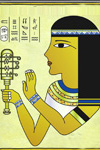 Sistrum SistrumAn important instrument in ancient Egyptian cosmogony, the Sistrum is used in ceremonies and dances for worshipping the Goddesses Hathor, Bast and Isis. It is also known as the Sheshesht or Iba. Shaped like the ankh, the Sistrum has a handle that is topped with a wooden or metal loop having wires that are strung with metal plates. Its constant shaking produces a jangling sound that is considered effective in appeasing Typhon, the God of chaos. The instrument is closely associated with Hathor, the Goddess of festivity, joy, dance, fertility, and eroticism. It also symbolizes her son, Ihy. With the mother and creator, Goddess Isis depicted as holding a pail in one hand and the Sistrum in the other, the instrument is even used for reducing the destructive effect of the flooded Nile. One of the most prominent representations of the Sistrum is to be found in Dendera in the temple of Hathor. Even today, this instrument is an important part of worship rites in the Ethiopian and Coptic churches. |
| Seba Seba is the Egyptian symbol for a star. This simple line drawing made of 5 equidistant spokes resembles a starfish. The term ‘seba’ means discipline or learning and it is associated with gates and doorways. The early Egyptian had a great interest in an extensive knowledge of the star-filled night sky. The stars had a great deal of influence on the development of their calendar and also dictated their beliefs in life after death. The ceilings of their temples were decorated with images of astral deities, constellations, and stars. The Egyptian sky goddess, Nut is also shown adorned with five-pointed stars. The stars were supposed to represent the souls of the dead and considered the followers of Osiris. The Seba in itself is representative of a star and the star-gods or constellations, but when it is enclosed within a circle, it comes to represent the Duat, the otherworld or the land of an afterlife to where the souls descend after death. |
 Flail and Crook Flail and Crook
A symbol of royalty, majesty, and dominion. |  Primordial Hill Primordial Hill
The Egyptians believed that during creation this hill rose out of the sea of chaos to create dry land. The idea of this hill rising had a profound effect on the Egyptians, being used as everything from temple layouts to the possible inspiration behind the pyramids. |
 Shen Shen
A loop of rope that has no beginning and no end, it symbolizes eternity. The sun disk is often depicted in the center of it. The Shen also seems to be a symbol of protection. It is often seen being clutched by deities in bird form, Horus the falcon, and Mut the vulture. Hovering over Pharaoh’s head with their wings outstretched in a gesture of protection. The word Shen comes from the word “Shenu” which means “encircle,” and in its elongated form became the cartouche which surrounded the king’s name. |  Udjat – Eye of Horus Udjat – Eye of Horus
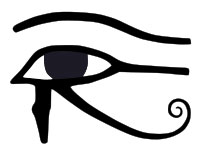
The sound eye of Horus. Symbolizes healing and protection. The eye is personified in the goddess Wadjet (also written as Wedjat, Uadjet, Wedjoyet, Edjo or Uto and as The Eye of Ra or “Udjat”). Horus was the ancient Egyptian sky god who was usually depicted as a falcon. His right eye was associated with the Sun Ra. The eye symbol represents the marking around a Peregrine Falcon’s eye that includes the “teardrop” marking sometimes found below the eye. The mirror image, or left eye, sometimes represented the moon and the god Djehuti (Thoth). |
 Ka Ka
The ka is usually translated as “soul” or “spirit” The ka came into existence when an individual was born. It was believed that the ram-headed god Khnum crafted the ka on his potter’s wheel at a person birth. It was thought that when someone died they “met their ka”. A person ka would live on after their body had died. Some tombs included model houses as the ka needed a place to live. Offerings of food and drink would be left at the tomb entrance so the ka could eat and drink. | 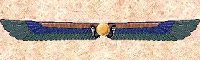 Winged Solar Disk Winged Solar Disk
This is a form that the god Horus Behudety (Horus of Edfu) takes in his battles with Seth. The god Thoth used his magic to turn Horus into a sun-disk with splendid outstretched wings. The goddesses Nekhbet and Uazet in the form of uraeus snakes joined him at his side. |
 Tiet Tiet
The exact origin of this symbol is unknown. In many respects, it resembles an ankh except that its arms curve down. Its meaning is also reminiscent of the ankh, it is often translated to mean welfare or life. As early as the Third Dynasty we find the Tiet being used as decoration when it appears with both the ankh and the Djed column, and later with the was the scepter. The Tiet is associated with Isis and is often called “the knot of Isis” or “the blood of Isis.” It seems to be called “the knot of Isis” because it resembles a knot used to secure the garments that the gods wore. The meaning of “the blood of Isis” is more obscured but it was often used as a funerary amulet made of a red stone or glass. In the Late Period, the sign was associated with the goddesses Nephthys, Hathor, and Nut as well as with Isis. In all these cases it seems to represent the ideas of resurrection and eternal life. |  Djew Djew
Which means mountain, the symbol suggests two peaks with the Nile valley in the middle. The Egyptians believed that there was a cosmic mountain range that held up the heavens. This mountain range had two peaks, the western peak was called Manu, while the eastern peak was called Bakhu. It was on these peaks that heaven rested. Each peak of this mountain chain was guarded by a lion deity, whose job it was to protect the sun as it rose and set. The mountain was also a symbol of the tomb and the afterlife, probably because most Egyptian tombs were located in the mountainous land bordering the Nile valley. In some texts, we find Anubis, the guardian of the tomb being referred to as “He who is upon his mountain.” Sometimes we find Hathor taking on the attributes of a deity of the afterlife, at this time she is called “Mistress of the Necropolis.” She is rendered as the head of a cow protruding from a mountainside. |
 Atef Atef
The Atef crown was worn by Osiris. It is made up of the white crown of Upper Egypt and the red feathers are representative of Busiris, Osiris’s cult center in the Delta. |  Khet Khet
This symbol represents a lamp or brazier on a stand from which a flame emerges. The fire was embodied in the sun and in its symbol the uraeus which spits fire. The fire also plays a part in the Egyptian concept of the underworld. There is one terrifying aspect of the underworld that is similar to the Christians concept of hell. Most Egyptians would like to avoid this place with its fiery lakes and rivers that are inhabited by fire demons. |
 Sesen Sesen
A Lotus Flower. A symbol of the sun, of creation and rebirth. Because at night the flower closes and sinks underwater, at dawn it rises and opens again. According to one creation myth, it was a giant lotus which first rose out of the watery chaos at the beginning of time. From this giant lotus, the sun itself rose on the first day. A symbol of Upper Egypt |  Leb Leb
This symbol represents a heart. The Egyptians believed the heart was the center of all consciousness, even the center of life itself. When someone died, it was said that their “heart has departed.” It was the only organ that was not removed from the body during mummification. In the Book of the dead, it was the heart that was weighed against the feather of Maat to see if an individual was worthy of joining Osiris in the afterlife. |
 Pshent Pshent
The Double Crown, the red crown, and the white crown are put together to represent a unified Egypt. Although Egypt was not always a unified nation, it was stronger that way. Therefore unification was desirable. Narmer (Menes), the founder of the First Dynasty around 3100 B.C., was the first man recorded wearing this crown. |  Nebu Nebu
This symbol represents gold which was considered a divine metal; it was thought to be the flesh of the gods. Its polished surface was related to the brilliance of the sun. Gold was important to the afterlife as it represents aspects of immortality. By the New Kingdom, the royal burial chamber was called the “House of Gold.” |