
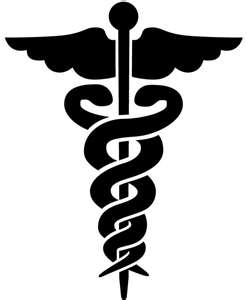
In Greek mythology, heralds or messengers generally carried with them a staff. Hermes, son of Zeus was a messenger of the god’s to the humans, and he carried one such herald’s staff called Kerykeion in Greek or caduceus in Latin. Hermes had a winged cap and winged sandals. His herald’s staff is likewise winged. It is a short rod, with two serpents coiled around it. The serpents’ heads meet just below the wing.
The caduceus has come to represent Hermes and all trades and undertakings associated with him. It also became the astrological symbol for the planet Mercury, named after the Roman counterpart of Hermes, and subsequently its metal namesake. Basically, everything that Mercury stood for is symbolized by the caduceus. Mercury is the Roman god of eloquence, commerce, money making, travel, and thievery. He was also believed to have invented all of the arts.
There is an ongoing controversy regarding the use of the caduceus as a symbol for the medical field, especially in American hospitals. The real symbol of medicine or the medical practice is the “rod of Asclepius”. Asclepius is the Greek god of healing and medicine. The rod of Asclepius doesn’t have wings and only 1 snake is coiled around it. The confusion is believed to have begun in the middle of the 19th century and has endured as a long and winded saga of what professionals and scholars consider “flimsy and pseudo-historical research”.


» Amulet
» Ajna
» Arsenic
» Merkaba
» Hung
» Yin Yang
» bindi
» IK Onkar
» Khanda
» Halo
» jiahu
» Tau
» Uraeus
» Menorah
» Quincunx
» Tilaka
» Taijitu
» Vajra
» Chai
» Chi Rho
» Bagua
» Dragon
» Hunab Ku
» Caduceus
» Infinity
» Ichthus
» Hedjet
» Lauburu
» Om
» Ankh
» Chalice
» Pentacle
» Maat
» Ogham
» Mandala
» Kartika
» Khamsa
» Heart
» Labrys
» Sun Face
» Raven
» Triskele
» Scarab
» Dove
» Hanukia
» Anubis
» Trishula
» Durga
» Mezuzah
» Bay Tree
» Geruda
» Kinnara
» Quito
» Condor
» Blue Jay
» Falcon
» Makara
» Rosary
» Uluru
» Apsaras
» Hanuman
» Serpent
» Minotaur
» Mercury
» Apex
» Vestra
» Yoni
» Astarte
» dakini
» Calabash
» Mandrake
» Rebis
» Typhon
» Vegvísir
